
Whalestein Stock Analysis: Applied Optoelectronics (AAOI)
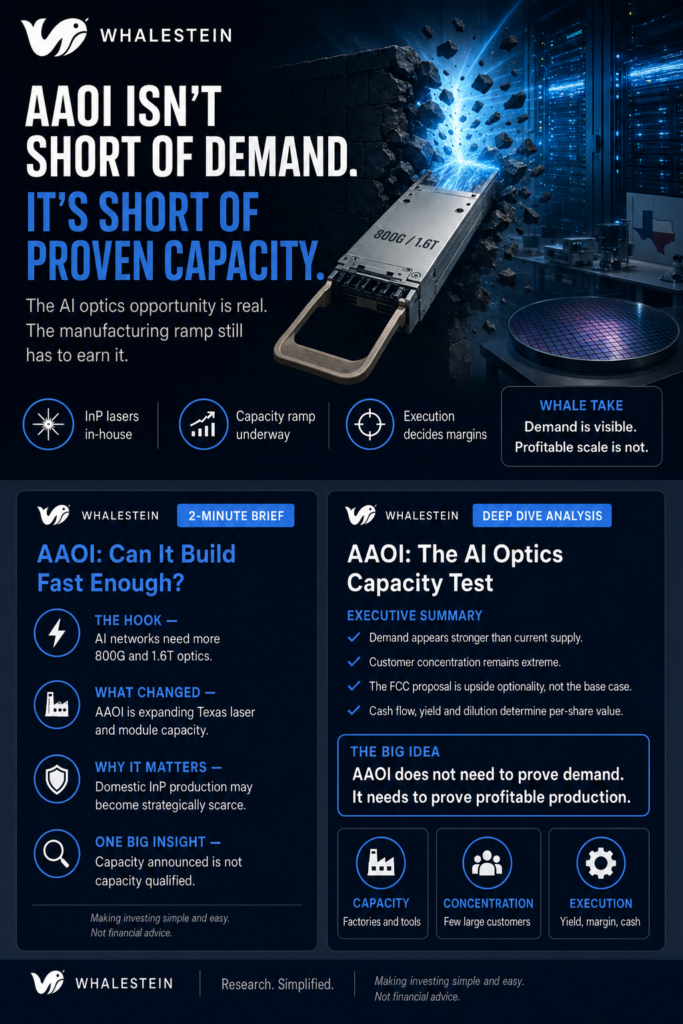
Can It Build Fast Enough?
Whalestein Research+ — Amended Edition
Research date: 6 August 2026
Status: Pre-Q2 2026 earnings; update required after the earnings release and conference call.
Executive Summary
AAOI is no longer primarily a story about whether demand for high-speed optical transceivers exists. Demand is visible across the AI data-centre supply chain. The investment question is whether AAOI can convert that demand into high-volume, high-yield production without destroying margins, cash flow, or shareholder value along the way.
The bull case is powerful: AAOI manufactures many of its own indium-phosphide laser chips in Texas, has received a volume order for 1.6T transceivers, and is making verifiable investments in new cleanrooms and semiconductor capacity. If its manufacturing ramp succeeds, AAOI could become a strategically important US supplier of 800G and 1.6T optics at a time when customers want more non-Chinese capacity.
The risk is equally clear. AAOI is attempting a roughly tenfold transceiver-capacity expansion from its late-2025 base. Customer concentration is extreme, working capital is absorbing cash, gross margin fell during the initial ramp, and equity issuance remains an important funding tool. The reported FCC restriction on new Chinese transceiver models could improve AAOI’s long-term strategic value, but no final rule exists. It should therefore be treated as optional upside—not as the foundation of the valuation.
Whalestein view
AAOI is a credible capacity story, but not yet a proven manufacturing story.
The market is already paying for substantial future success. The next stage of the thesis must be validated through shipped units, yields, gross margin, cash conversion, and actual hyperscaler revenue—not announcements alone.
The Core Thesis in Plain English
AI clusters require enormous amounts of data to move between accelerators, switches, and racks. Optical transceivers convert electrical signals into light so that this data can travel quickly and efficiently.
As networks migrate from 400G to 800G and then 1.6T, demand for faster optics rises. But producing these modules at scale is difficult. Companies require laser capacity, optical components, packaging, testing equipment, automation, skilled engineers, customer qualification, and acceptable manufacturing yields.
AAOI’s opportunity is straightforward:
- AI infrastructure is creating strong demand for high-speed optics.
- Supply is constrained, particularly in laser and advanced optical manufacturing.
- AAOI makes many of its own InP laser chips and is expanding US production.
- Customers may value a domestic, non-Chinese source more highly if US restrictions tighten.
- If AAOI executes, revenue and earnings could scale rapidly.
- But the word if carries most of the investment risk.
1. Capacity: Real Construction, Unproven Output
What is verified
AAOI is putting real capital behind its expansion.
A February 2026 SEC filing documents an approximately $30.9 million design-build contract for about 92,674 square feet of ISO Class 6 cleanroom space at its Sugar Land FAB2 project.
A June 2026 SEC filing documents an approximately $94.1 million contract for the OMD 3/FAB4 project in Houston, including roughly 195,591 square feet of cleanroom space. Substantial completion is targeted for January 2027.
Texas awarded AAOI a $20.85 million semiconductor grant supporting an expansion representing more than $279 million of capital investment and an expected 500 jobs.
AAOI states that all of its laser chips are manufactured at its Sugar Land facility and that it manufactures the majority of the laser chips and optical components used in its products.
These facts matter because they distinguish physical expansion from a presentation-slide promise.
What remains management guidance
Management has discussed a path from approximately 90,000–100,000 high-speed modules per month around the turn of 2026 toward more than 500,000–650,000 by the end of 2026 and still higher capacity during 2027. The precise figures differ depending on whether management is describing specific sites, product combinations, or worldwide capacity.
These targets should not be treated as achieved capacity. A completed cleanroom is not the same as qualified output. Equipment must be installed, processes tuned, yields stabilized, workers trained, and products approved by customers.
Important correction to the original analysis
The earlier draft used an estimate of approximately $120 million per 100,000 monthly units and extrapolated it linearly to imply more than $1 billion of total investment. We should not publish that conclusion as fact.
Manufacturing costs do not necessarily scale in a straight line. Facilities share infrastructure, product mixes differ, utilisation changes, and later capacity may benefit from automation or larger wafers. Without a company-confirmed total-capex bridge, the linear extrapolation creates false precision.
Whalestein assessment
The expansion is credible enough to monitor, but not proven enough to underwrite fully.
The most important evidence is no longer square footage. It is:
- qualified monthly output
- shipped 800G and 1.6T units
- manufacturing yield
- on-time delivery
- gross margin during the ramp; and
- customer acceptance.
2. Vertical Integration: A Genuine Advantage, Not Immunity
AAOI’s strongest industrial advantage is its internal InP laser capability.
Indium phosphide, or InP, is a semiconductor material used to produce lasers capable of transmitting data at very high speeds. In a constrained market, owning part of this laser supply can provide better control over cost, availability, product design, and security of supply.
This matters because some module assemblers depend more heavily on external laser suppliers. AAOI’s internal laser production therefore gives the company a more credible route to scaling than a business that must source every critical optical component from outside vendors.
However, “vertically integrated” does not mean “fully insulated.” AAOI can still face constraints in:
- InP substrates and epitaxial materials
- driver and DSP components
- packaging and alignment equipment
- testing capacity
- firmware and product qualification
- labour and automation; and
- manufacturing yield.
Nvidia’s investments in Coherent and Lumentum reinforce the strategic value of laser capacity, but they should not be described as Nvidia locking up every available EML or pushing all other customers beyond 2027. The arrangements strengthen Nvidia’s access; they do not prove universal exclusivity.
Whalestein assessment
AAOI’s laser fab improves the probability of successful execution. It does not remove execution risk.
3. Customer Concentration: The Most Underappreciated Risk
The customer data materially changes how investors should understand AAOI.
According to AAOI’s 2025 10-K:
| Metric | 2023 | 2024 | 2025 |
|---|---|---|---|
| Top-ten customers as % of revenue | 92.7% | 95.0% | 96.6% |
| Digicomm as % of revenue | 11.3% | 34.1% | 53.1% |
| Microsoft as % of revenue | 46.6% | 43.7% | 28.8% |
Digicomm and Microsoft together represented 81.9% of 2025 revenue.
This means AAOI’s recent financial base was not a diversified basket of AI hyperscalers. More than half of 2025 revenue came from Digicomm, a CATV distributor, while Microsoft was the largest data-centre customer.
The first quarter of 2026 showed some improvement in revenue mix but not in overall concentration:
- data-centre revenue rose to 53.9% of consolidated revenue
- the top ten customers still represented 98% of revenue
- Digicomm generated approximately 44.1% of revenue; and
- Digicomm represented approximately 74.5% of accounts receivable.
AAOI said it had extended longer-than-typical payment terms to Digicomm so that the distributor could hold adequate inventory. AAOI also noted that its collection history with Digicomm had been good. Nevertheless, this creates both customer-concentration risk and working-capital risk.
Why this matters
The AI thesis may be correct while quarterly results remain heavily influenced by cable-network spending, shipment timing, and the financial behaviour of one distributor.
Future hyperscaler growth could reduce Digicomm’s percentage. But replacing CATV concentration with two or three hyperscalers would improve the narrative more than it improves diversification.
Amazon: separate opportunity from booked revenue
AAOI’s Amazon arrangement includes a warrant whose additional shares can vest depending on up to $4 billion of aggregate Amazon purchases over ten years. This is not a $4 billion backlog or guaranteed order.
The correct interpretation is:
Amazon has a framework that rewards substantial future purchasing, but revenue exists only when products are actually ordered and shipped.
Similarly, AAOI’s announced 1.6T volume order is meaningful evidence of customer interest, but the customer was not named and the announcement should not automatically be converted into a specific hyperscaler revenue forecast.
4. The Proposed FCC Restriction: Strategic Tailwind, Not Current Earnings
Reuters reported on 4 August 2026 that the US administration was drafting a restriction on imports of new Chinese data-centre transceiver models. The reported structure would initially restrict new models and then exempt many non-Chinese suppliers.
This is important—but it is not yet a final rule.
Reuters also reported that the measure could still be modified or shelved. Until the FCC publishes formal language, investors do not know:
the exact products covered;
whether the restriction applies through equipment-authorisation rules, import rules, or another mechanism;
how “new model” will be defined;
what happens to upgrades or product modifications;
which suppliers receive exemptions;
the effective date; or
whether waivers or transition periods will be granted.
What the market may be assuming
The market appears to be pricing a future shift in US design wins from Chinese suppliers such as Zhongji Innolight toward non-Chinese vendors including AAOI, Coherent, Lumentum, and Cisco/Acacia.
That direction is plausible. But the timing and size of the benefit are uncertain.
Why an immediate, complete ban may be difficult
Chinese manufacturers account for a large portion of global transceiver supply. Western vendors cannot necessarily replace that volume immediately—especially while the industry is already constrained by lasers, test equipment, qualification cycles, and manufacturing yields.
A rule that removes supply faster than alternatives can ramp could raise optical prices or delay parts of the US data-centre buildout. Hyperscalers would therefore have strong incentives to seek transition periods, grandfathering, or exemptions.
Important correction to the original analysis
FCC precedent is useful, but a handful of earlier actions does not prove that the transceiver measure will follow the same timetable or become broader in exactly the same way. Optical transceivers have different supply-chain importance and potentially different regulatory mechanics.
It is reasonable to expect that already deployed equipment will not be physically removed. It is not yet safe to state as fact that the entire certified 800G base will continue unchanged through 2027. That conclusion depends on final definitions and treatment of product modifications.
Whalestein policy framework
Treat the policy catalyst in three stages:
- Headline stage — current: sentiment and multiple expansion; no dependable revenue impact.
- Rule stage: formal scope, exemptions, timing, and grandfathering become known.
- Order stage: customers award new design wins and capacity commitments to AAOI.
Only the third stage creates durable earnings value.
5. Could the Restriction Hurt Hyperscalers?
Yes. This is the strongest insight in the outside thesis the user shared.
A restriction can be positive for AAOI and negative for the broader US AI buildout at the same time.
If Chinese modules are removed from future platforms faster than Western production expands, the likely effects are:
- higher transceiver prices
- longer lead times
- customer prepayments or capacity-reservation agreements
- greater bargaining power for trusted suppliers; and
- possible delays to some cluster deployments.
The most probable policy design is therefore not “China disappears overnight.” A phased transition with existing-product treatment and exemptions for trusted suppliers would better balance national security with AI-infrastructure deployment.
For AAOI, the highest-quality opportunity is not replacing every Chinese 800G module immediately. It is winning more US 1.6T qualifications, securing customer-funded capacity, and earning premium pricing as a strategically important domestic supplier.
6. Financial Reality: Growth Is Consuming Cash
First-quarter 2026 revenue reached $151.1 million, including $81.4 million of data-centre revenue. But the ramp was financially demanding:
- gross margin fell to 29.1% from 30.6% a year earlier
- operating cash outflow was approximately $85.4 million
- capital expenditure was approximately $58.2 million; and
- accounts receivable increased, with Digicomm responsible for a large concentration.
A simple operating-cash-flow-minus-capex measure therefore indicates cash consumption of roughly $143.6 million during the quarter. This is useful as a warning indicator, although it should not be treated as normalized free cash flow during a major expansion.
AAOI also used equity financing. The Q1 filing described a $250 million at-the-market programme established in February 2026. Investors should verify any later programmes or increases directly from subsequent filings rather than relying on an aggregated “$600 million ATM” claim.
Why dilution matters
Revenue can rise sharply while per-share value disappoints if the company repeatedly issues shares to fund working capital and factories.
The correct unit of analysis is therefore not only company revenue or EBITDA. It is future cash earnings per diluted share.
7. Valuation: Use Scenarios, Not Analyst Targets
The original draft devoted too much weight to analyst targets and third-party “fair value” screens.
Price targets are outputs of assumptions. They do not independently validate the thesis. Black-box valuation scores are especially weak for a company transitioning from losses into a high-growth manufacturing ramp.
AAOI is better analysed through scenarios:
Bear case — capacity or qualification slips
- revenue ramp misses expectations
- new factories operate below planned utilisation
- gross margin remains pressured
- working-capital needs remain high
- dilution continues; and
- the valuation multiple compresses sharply.
Base case — meaningful ramp, imperfect execution
- 800G shipments scale during 2026
- 1.6T contributes more materially in 2027
- data-centre revenue diversifies the CATV mix
- gross margin improves gradually as utilisation rises; and
- policy provides modest design-win support rather than immediate replacement demand.
Bull case — successful scale plus strategic scarcity
- capacity arrives largely on schedule
- yields and product reliability meet hyperscaler requirements
- multiple customers commit to large 1.6T volumes
- US policy increases the value of domestic supply
- customers help fund expansion or reserve capacity; and
- operating leverage produces substantial cash earnings.
Valuation discipline
Forward sales multiples may help compare scenarios, but they must be paired with future gross margin, operating expense, capex, and diluted share count. Two companies with the same revenue deserve very different valuations if one converts revenue into cash while the other continually requires new capital.
8. What Would Confirm or Break the Thesis?
Confirmation signals
- 800G and 1.6T shipments rise consistently.
- Management converts capacity targets into qualified, saleable output.
- Data-centre gross margin improves as utilisation increases.
- Operating cash consumption narrows after the expansion phase.
- Digicomm’s revenue and receivables concentration declines without CATV revenue collapsing.
- A second or third hyperscaler becomes a material revenue customer through actual shipments.
- Customer prepayments or capacity agreements fund expansion on attractive terms.
- A formal US rule clearly favours AAOI-addressable products.
Thesis-break signals
- factory or equipment schedules slip repeatedly
- product qualification or firmware problems delay shipments
- unit growth fails to produce gross-margin improvement
- receivables rise faster than revenue or collection quality deteriorates
- a major customer reduces orders
- dilution outpaces per-share earnings growth
- 1.6T demand moves to architectures where AAOI has weak positioning; or
- the FCC proposal is shelved after the stock has already priced in the benefit.
Whalestein Scorecard
| Lens | Score | Why |
|---|---|---|
| Structural demand | 9/10 | AI networks require increasing optical bandwidth. |
| Strategic positioning | 8/10 | US manufacturing and internal InP lasers are valuable. |
| Capacity credibility | 7/10 | Construction and spending are verified; production targets remain unproven. |
| Customer quality | 7/10 | Microsoft and hyperscale relationships matter, but CATV remains influential. |
| Customer diversification | 2/10 | Concentration is extreme and worsening on the top-ten measure. |
| Margin visibility | 5/10 | Scale can help, but the early ramp is pressuring efficiency. |
| Balance-sheet/cash-flow quality | 4/10 | Cash exists, but capex and working capital consume substantial funding. |
| Policy optionality | 7/10 | Potentially significant, but no final FCC rule exists. |
| Valuation margin of safety | 3/10 | Expectations are high and downside from execution misses can be severe. |
| Overall thesis quality | 7/10 | Powerful opportunity with unusually high execution and financing risk. |
Bottom Line
AAOI may become one of the most strategically important US optical-transceiver suppliers in the AI era. The demand environment, internal laser capability, hyperscaler engagement, and physical factory expansion give the thesis substance.
But investors should not confuse capacity announced with capacity qualified, or customer frameworks with booked revenue.
The reported FCC restriction strengthens the strategic story, but it does not solve AAOI’s central challenge. The company must still manufacture hundreds of thousands of reliable modules, deliver them on time, improve margins, collect cash, and control dilution.
One Thing to Remember
AAOI does not need to prove that AI needs more optics. It needs to prove that AAOI can manufacture those optics profitably at scale.
That is the thesis.
Source Notes
Primary and high-quality sources used for the amendments:
- AAOI 2025 Form 10-K — customer concentration, revenue mix, internal laser production
- AAOI Q1 2026 Form 10-Q — revenue, margin, cash flow, capex, receivables, Amazon warrant and ATM
- AAOI FAB2 design-build filing — approximately $30.9 million
- AAOI OMD 3/FAB4 design-build filing — approximately $94.1 million
- Texas Semiconductor Innovation Fund grant announcement
- AAOI 1.6T volume-order announcement
- Reuters — reported draft restriction on new Chinese data-centre transceiver models
Making investing simple and easy. Not financial advice.