

Whalestein Stock Analysis: AMD
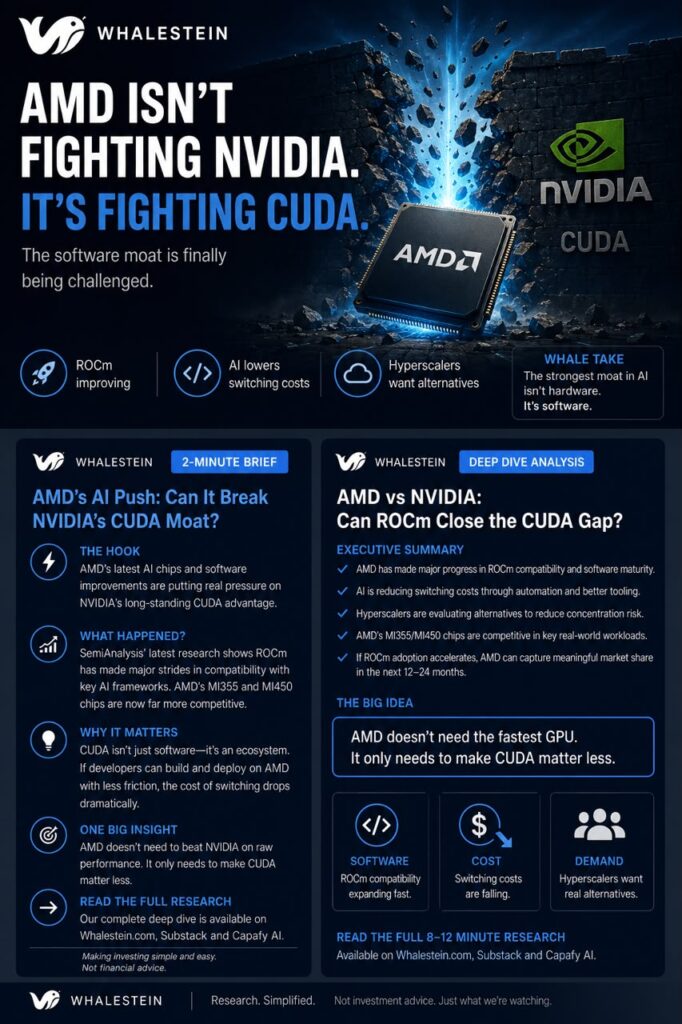
AMD Isn’t Fighting NVIDIA. It’s Fighting CUDA.
Can AMD become the second major AI computing platform?
Whalestein Deep Dive — 10-minute read
Executive Summary
AMD’s AI opportunity is no longer only about whether its GPUs can match NVIDIA on specifications. The more important battle is whether AMD can make its ROCm software platform reliable, accessible and compatible enough that developers and hyperscalers can deploy AMD hardware without suffering major productivity losses.
SemiAnalysis’ latest research argues that AMD’s software quality has improved materially, but also warns that NVIDIA’s moat has moved beyond basic CUDA compatibility. NVIDIA now competes through integrated systems, networking, deployment speed, mature libraries and rapid software optimization.
AMD does not need to replace NVIDIA. It needs to become a credible second platform. If ROCm continues improving, AI tools reduce software-porting costs and hyperscalers keep seeking alternatives, AMD could capture meaningful AI infrastructure spending.
The opportunity is real, but the next stage depends less on benchmark slides and more on production-scale execution.
The Big Idea
AMD doesn’t need the fastest GPU. It needs to make CUDA matter less.
For more than a decade, NVIDIA’s strongest competitive advantage has not been one specific GPU.
It has been CUDA.
CUDA gives developers access to mature libraries, compilers, debugging tools, communication software, documentation and an enormous installed base of optimized applications.
This creates switching costs.
A company may find a competing GPU attractive on paper, but changing platforms can require software rewrites, testing, performance tuning, infrastructure redesign and employee retraining.
That is why AMD’s real challenge is not simply building competitive silicon.
It must reduce the pain of leaving NVIDIA.
Why This Matters
NVIDIA currently benefits from a powerful cycle:
More developers → more optimized software → better real-world performance → more customers → more developers.
AMD needs to interrupt that cycle.
If frameworks such as PyTorch and vLLM abstract away more of the underlying hardware, developers may care less about whether their workloads run on an NVIDIA or AMD GPU.
ROCm is now a broad open software stack covering runtimes, compilers, development tools and optimized libraries. AMD’s documentation also identifies PyTorch and other AI frameworks as part of the broader ROCm ecosystem.
The investment question is therefore changing from:
Can AMD build a competitive GPU?
to:
Can companies deploy AMD at scale without sacrificing too much time, reliability and performance?
What Changed?
1. ROCm has improved significantly
SemiAnalysis previously criticized AMD’s software quality, deployment experience and quality-assurance processes. Its latest work is more constructive: ROCm is no longer dismissed as fundamentally broken, and AMD is showing greater urgency.
AMD has also continued releasing stability and performance improvements. ROCm 7.2.4, for example, focused specifically on performance and stability fixes for AI inference workloads.
The important point is not that ROCm has reached CUDA parity.
It has not.
The important point is that ROCm is becoming usable enough for serious deployments.
2. AMD is becoming more integrated into major AI frameworks
In January 2026, AMD said ROCm had become a first-class platform within the vLLM ecosystem, including official wheels and validated support for several Instinct accelerators.
This matters because most AI developers do not want to work directly with low-level GPU code.
They use frameworks.
When those frameworks support AMD properly, the underlying hardware becomes less visible to the developer.
That weakens CUDA’s grip at the application layer.
3. AI can lower migration costs
Historically, porting and optimizing workloads for a new accelerator required scarce GPU engineers.
AI coding agents can increasingly assist with code translation, kernel generation, debugging and performance optimization.
AMD has now launched ROCm.AI, an AI-native development experience that includes AI-assisted development and AI-powered software optimization.
This does not eliminate CUDA’s moat, but it may reduce the cost of crossing it.
That is strategically important.
4. AMD’s hardware is increasingly credible
The MI350 series offers up to 288GB of HBM3E memory and up to 8TB/s of theoretical memory bandwidth. AMD positions it for both AI training and inference workloads.
AMD has also moved toward rack-scale systems through its MI400 family and Helios platform, showing that it understands the market is no longer only about individual accelerators.
However, strong specifications do not automatically translate into strong production performance.
SemiAnalysis’ benchmarking has shown that AMD can be highly competitive in selected workloads, but software performance remains inconsistent and NVIDIA often retains an advantage in newer precision formats and large-scale deployment efficiency.
5. The financial base is strengthening
AMD generated record full-year 2025 Data Center revenue of $16.6 billion, up 32% year over year, driven by EPYC processors and continued Instinct GPU growth.
In the first quarter of 2026, total company revenue reached $10.3 billion, up 38% from the prior-year period.
This gives AMD more resources to fund software, systems, networking and developer support.
The AI strategy is no longer being built from a weak financial position.
What the Market May Be Missing
The market often treats AMD as a smaller NVIDIA:
- NVIDIA has the fastest platform.
- AMD has the cheaper alternative.
- Therefore, AMD remains permanently second.
That may be too simplistic.
AMD’s opportunity is not necessarily to win the entire accelerator market.
It is to become the default alternative.
Hyperscalers do not want one supplier controlling pricing, availability and roadmaps across their entire AI infrastructure.
A credible second platform gives them:
- greater bargaining power
- supply-chain diversification
- workload flexibility
- lower concentration risk
- more control over infrastructure economics.
AMD does not need every customer to abandon NVIDIA.
It needs customers to move selected inference, training or internal workloads onto AMD in sufficient volume.
The market may also underestimate how quickly software switching costs can fall once AI-assisted development becomes reliable.
The Investment Chain
AMD success would affect more than AMD itself.
AMD — Direct beneficiary
AMD gains directly through accelerator revenue, system revenue and potentially higher margins.
The strongest upside would come if customers move from small pilot deployments into repeat, production-scale orders.
The key metric is not one benchmark win.
It is sustained platform adoption.
TSMC — High-confidence manufacturing beneficiary
AMD’s advanced accelerators depend on leading-edge manufacturing and advanced packaging.
If AMD gains AI market share, TSMC receives more wafer and packaging demand.
TSMC also benefits if NVIDIA continues winning, making it a less directional way to participate in AI compute growth.
Investment interpretation: AMD success expands TSMC’s opportunity, but TSMC does not require AMD to defeat NVIDIA.
HBM suppliers — High-confidence memory beneficiary
AI accelerators require large quantities of high-bandwidth memory.
The MI350 series includes up to 288GB of HBM3E per GPU.
More AMD accelerator shipments therefore create incremental HBM demand.
SK Hynix, Micron and Samsung are exposed to the broader accelerator cycle, although actual benefits depend on supplier qualification and allocation.
Investment interpretation: HBM demand benefits from AI accelerator diversification, not only NVIDIA growth.
Networking and connectivity — Moderate-to-high confidence
More accelerator clusters require more switches, retimers, DSPs, cables and optical connections.
Potential beneficiaries include:
- Marvell
- Astera Labs
- Credo
- optical-transceiver suppliers such as AAOI.
The relationship is indirect.
AMD deployments must grow at scale, and each supplier’s benefit depends on customer architecture and content share.
Investment interpretation: AMD is one possible demand driver inside a much larger AI networking cycle.
Cooling, power and data-centre infrastructure — High-confidence thematic beneficiary
Whether the GPU is supplied by AMD or NVIDIA, AI racks require:
- power distribution
- liquid cooling
- backup systems
- thermal management
- data-centre capacity.
Vertiv and other infrastructure suppliers benefit from the total growth of accelerated computing.
Investment interpretation: These companies are less dependent on which chip architecture wins.
Electricity providers — Long-duration beneficiary
More accelerators mean more power consumption.
However, the investment case for utilities and power producers depends on geography, contracts, generation mix, regulatory conditions and data-centre project completion.
Investment interpretation: The connection is real, but much less direct than the link between AMD and TSMC or HBM.
Counter Thesis
1. CUDA is still far ahead
ROCm improving does not mean ROCm has matched CUDA.
NVIDIA possesses mature libraries, developer tools, documentation, enterprise support and extensive optimization across thousands of workloads.
SemiAnalysis has also shown that ROCm can still produce weaker accuracy or inconsistent performance in certain environments.
The moat may be narrowing in places, but it remains substantial.
2. NVIDIA is moving faster too
AMD is improving, but NVIDIA is not standing still.
The competitive frontier has moved from individual chips to:
- complete racks
- networking
- communication libraries
- software deployment
- system-level optimization
- rapid iteration.
AMD must close a moving gap.
3. Hyperscalers have their own chips
AMD is not only competing against NVIDIA.
Google has TPUs.
Amazon has Trainium.
Microsoft and Meta are developing internal accelerators.
Customers seeking alternatives to NVIDIA may choose their own custom silicon rather than AMD.
4. Being “good enough” may not be sufficient for frontier training
For cost-sensitive inference, a second platform can be attractive.
For large frontier-model training, reliability, scale, communication performance and developer productivity may matter more than accelerator price.
NVIDIA remains difficult to displace in the highest-value deployments.
5. Execution risk remains high
AMD must simultaneously execute across:
- silicon
- software
- networking
- rack-scale systems
- cloud availability
- enterprise support
- developer relations.
A delay or quality problem in one layer can weaken the entire platform.
Whalestein 10-Lens Analysis
1. Technology Leadership — 8.4/10
AMD’s accelerator hardware is credible, particularly in memory capacity and selected inference and training workloads.
However, NVIDIA still leads at the full-system level.
What would raise the score: consistent independent wins across production workloads.
What would lower it: delays, weak utilization or widening system-level performance gaps.
2. Software Ecosystem — 7.4/10
ROCm is improving rapidly, with broader framework support and more frequent releases.
CUDA remains the industry standard.
What would raise the score: easier installation, stronger documentation, broader library parity and fewer workload-specific failures.
What would lower it: continuing instability or inconsistent performance across releases.
3. Execution Capability — 7.6/10
AMD has demonstrated greater urgency and a more coherent product roadmap.
The challenge is delivering the entire stack reliably.
What would raise the score: successful production deployments of MI350 and MI400 systems.
What would lower it: launch delays, supply issues or software regressions.
4. Customer Adoption — 8.2/10
Cloud providers and major AI customers have strong economic reasons to support an alternative.
Adoption is likely to begin with selected workloads rather than complete platform replacement.
What would raise the score: repeat orders and multi-year capacity commitments.
What would lower it: pilots that fail to convert into production demand.
5. Competitive Moat — 7.1/10
AMD’s open software approach and CPU-GPU portfolio provide strategic value.
Its moat is still much weaker than NVIDIA’s ecosystem advantage.
What would raise the score: a self-reinforcing developer and customer ecosystem.
What would lower it: commoditization or stronger custom-chip competition.
6. Financial Upside — 8.6/10
AI accelerators offer significant revenue and margin expansion potential.
AMD does not need majority market share for AI to materially affect its earnings.
What would raise the score: accelerating Instinct revenue and improving data-centre margins.
What would lower it: aggressive pricing without sufficient volume.
7. Industry Positioning — 9.3/10
AMD is positioned directly inside accelerated computing, data-centre CPUs and AI infrastructure.
Few companies have comparable exposure across both CPUs and GPUs.
What would raise the score: stronger rack-scale integration and networking.
What would lower it: slowing AI infrastructure spending.
8. Valuation Risk — 6.8/10
AMD’s valuation can move ahead of demonstrated AI earnings.
Investors may price in future market share before deployment evidence appears.
What would raise the score: earnings growth catching up with expectations.
What would lower it: missed guidance or weaker AI revenue conversion.
9. Risk Profile — 6.6/10
The main risks are CUDA’s durability, custom accelerators, execution complexity, export controls and intense competition.
AMD offers considerable upside, but the thesis requires multiple things to go right.
10. Long-Term Conviction — 8.5/10
AMD has evolved from a speculative GPU alternative into a credible candidate for the industry’s second major AI platform.
It does not need to beat NVIDIA outright.
It needs to become reliable enough that customers can use both.
Overall Whalestein Rating: 8.1/10
Investment view: AMD represents a high-upside but execution-dependent AI infrastructure thesis. The strongest case is not that AMD will dethrone NVIDIA, but that the accelerator market becomes large enough to support a durable second ecosystem.
One Thing to Remember
The strongest moats are not always destroyed. Sometimes they become less essential.
AMD may never replace CUDA.
But if developers, frameworks and AI tools make hardware switching easier, AMD can capture meaningful share without winning the entire market.
That would be enough to reshape the economics of AI infrastructure.
Research Workflow
Original research and inspiration
- SemiAnalysis — Can AMD Break the CUDA Moat? AMD Advancing AI 2026
- SemiAnalysis AMD benchmarking and prior software analysis
- AMD financial filings, product materials and ROCm documentation
Whalestein’s contribution
- Independent counter-thesis
- Investment-chain analysis
- 10-Lens evaluation
- Separation of direct and indirect beneficiaries
- Mental-model synthesis
Making investing simple and easy. Not financial advice.